/Silver: Bloomberg Notes London Panic as India Sells Out
Silver: Bloomberg Notes London Panic as India Sells Out
By Scottsdale Mint
on
How the Silver Market Broke
The “Unexpected” Shortage
For months, Vipin Raina had prepared for a surge in silver demand during India’s festival season. Yet when the rush arrived, it exceeded every forecast. At the start of the week, MMTC-Pamp India Pvt, the country’s largest precious-metals refinery, ran out of silver for the first time in its history.
“Most people dealing silver and silver coins are literally out of stock because silver is not there,” said Raina. “This kind of crazy market — where people are buying at these levels — I have not seen in my 27-year career.”
By week’s end, shortages spread far beyond India. International investors and hedge funds joined the buying frenzy, seeking refuge from a weakening dollar or chasing the market’s momentum. London, the world’s benchmark hub for silver pricing, soon found itself drained of available metal.
Bloomberg’s Account
Bloomberg’s account draws on more than two dozen traders, bankers, refiners, and investors. They describe a system strained to its limits, where even major banks stopped quoting prices as clients shouted down phone lines in frustration. Prices spiked above $54 an ounce before plunging nearly 7 percent, exposing the worst stress in the silver market since the Hunt Brothers’ 1980 attempt to corner supply.
India’s Festival Spark
Analysts largely agree on the trigger: India. During the Diwali season, millions purchase jewelry to honor the goddess Lakshmi. Traditionally the focus is gold, but this year silver captured attention.
“The demand this time for silver has been humongous,” said Amit Mittal of M.D. Overseas Bullion.
A social-media campaign fueled the switch. Influencers like Sarthak Ahuja told followers that silver’s 100-to-1 price ratio to gold made it the next big trade. His April video went viral, setting the stage for record buying during Akshaya Tritiya and Dhanteras.
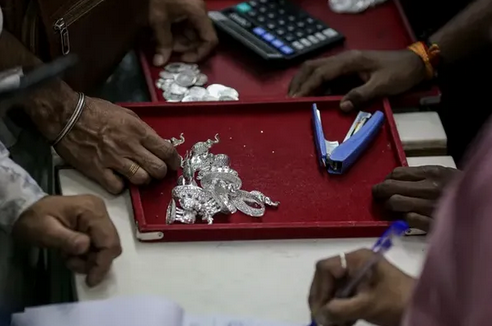
Silver products at a jewelry store in Mumbai.Photographer: Dhiraj Singh/Bloomberg
The Chain Reaction
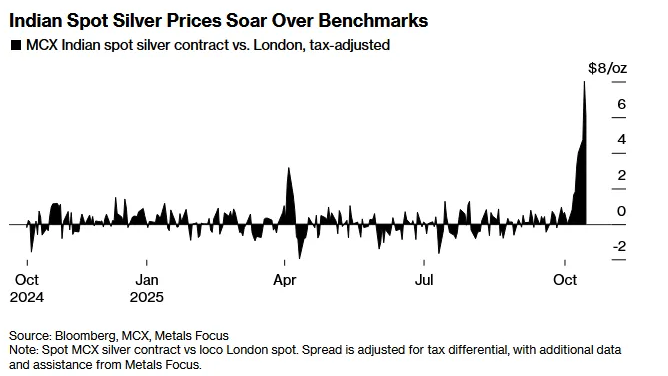
Local premiums over global prices climbed from mere cents to more than a dollar per ounce. At the same time, China — a critical supplier — shut down for a week-long holiday, forcing dealers to turn to London’s vaults.
Those vaults held more than $36 billion worth of silver, but most belonged to exchange-traded funds. ETF investors, engaged in the so-called “debasement trade” against the U.S. dollar, had absorbed over 100 million ounces in 2025 alone, leaving little free metal for physical demand.
“ETF investors have hoovered up more than 100 million ounces of silver since the start of 2025,” Bloomberg reported.
JPMorgan Chase, the largest bullion supplier to India, told at least one client it could not deliver further silver until November. As a result, Indian bullion dealers ran out of stock, and multiple local ETFs including Kotak Asset Management and UTI suspended new subscriptions.
Panic in London
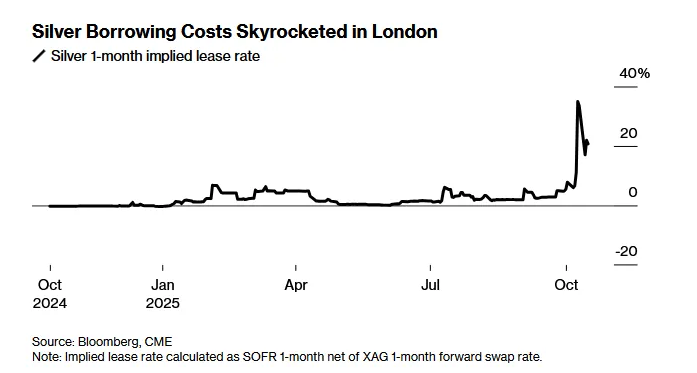
By October 9, with Dhanteras approaching, London’s market reached breaking point. Liquidity collapsed as the overnight borrowing cost for silver hit an annualized 200 percent, according to Metals Focus.
“There is more or less little to no liquidity actually available in terms of leases in London,” said Robin Kolvenbach, co-CEO of Argor-Heraeus.
Bid-ask spreads widened beyond usability. Traders reported absurd price gaps between major banks, enabling arbitrage profits within seconds — a rare sign of dysfunction in a trillion-dollar market.
LBMA Can’t Break the Squeeze
Historically, regulators intervened when silver dislocations grew severe. In 1980, exchanges restricted new buying to stop the Hunt Brothers’ corner.In 1998, after Warren Buffett’s Berkshire Hathaway purchased a quarter of global mine output, the LBMA eased delivery rules to calm prices. This time, insiders say, the LBMA chose not to act, viewing the crisis as a real shortage, not a logistical delay. Over the past five years, demand from the solar-power industry has consistently exceeded supply, creating a structural deficit of 678 million ounces since 2021.
The recent decision to add silver to the U.S. critical minerals list marks an important shift in how policymakers view the metal. The designation signals that silver is no longer treated as a simple commodity but as an asset tied to industrial capacity, technological development, and national security. Analysts and policymakers alike emphasize that this recognition places silver in the same category of strategic concern as lithium, uranium, and rare earths. This is not helping the LBMA keep silver in stock
Tariffs, ETFs, and the Drain on London
The squeeze was worsened by traders front-running potential Trump administration tariffs on critical minerals. Roughly 200 million ounces were shipped to New York warehouses earlier in the year, while ETFs absorbed another 100 million. That left fewer than 150 million ounces of unencumbered silver in London.
Customers purchase silver jewelry at a store in Mumbai on Oct. 17.Photographer: Dhiraj Singh/Bloomberg
As prices spiked, traders attempted to ferry bars back from New York — a process that can take four days under ideal conditions, or weeks when customs delays strike.
“Comex inventories have fallen by more than 20 million ounces in two weeks — the largest drawdown in 25 years,” Bloomberg noted.
After the Break
By late October, the panic began to ease as shipments arrived from Comex and Asia. Yet analysts warned that the underlying imbalance remained. Daniel Ghali at TD Securities, who had cautioned for over a year that London was courting a squeeze, called the timing of his short recommendation premature but stood by the thesis.
“We certainly did not expect the scale of the retail-buying bonanza across the globe that ensued while the London market was getting squeezed,” said Ghali.
But Josh Phair, CEO of Scottsdale Silver did just that in July of this year in a brief informational video titled: The Metal Minerals War is On
About the Author
Vincent Lanci is a commodity trader, Professor of MBA Finance (adj.) , and publisher of theGoldFixnewsletter.