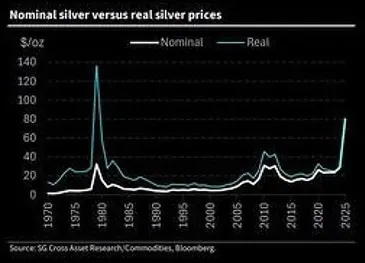
The question of whether silver is in a speculative bubble has re-emerged following its rapid move above $80 per ounce. Price action of that magnitude, particularly when viewed on a conventional linear chart, can appear abrupt and emotionally driven. However, chart construction matters, and the analytical conclusions drawn from different scales can diverge meaningfully.
According to Société Générale Commodity Research, models may initially suggest bubble-like behavior, but those signals require careful interpretation and should not be treated as forecasting oracles.
Linear Versus Logarithmic Price Interpretation
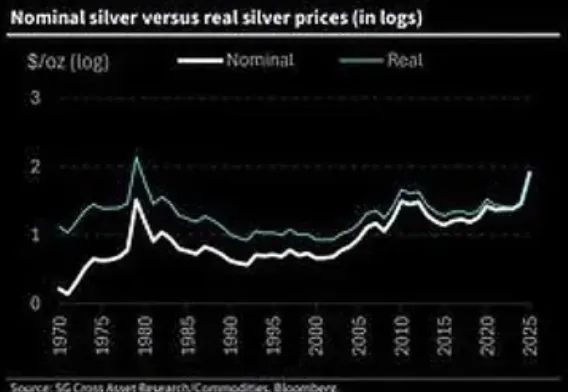
Most commentary assessing silver’s recent surge relies on linear price charts. On that scale, the near-vertical advance naturally looks extreme. When the same price history is plotted on a logarithmic scale, however, the narrative shifts materially.
On a log scale, silver’s long-term behavior reflects a persistent compounding trend that has been in place for roughly 25 years. While the most recent acceleration remains notable even in logarithmic terms, it does not appear historically unprecedented.
“Viewed logarithmically, silver continues to follow a long-running compounding trend, although the current phase is unusually strong.”
The logarithmic framework is emphasized because it better captures exponential growth processes and reduces the visual distortion caused by large absolute price changes at higher nominal levels.
Identifying Bubble Dynamics Properly
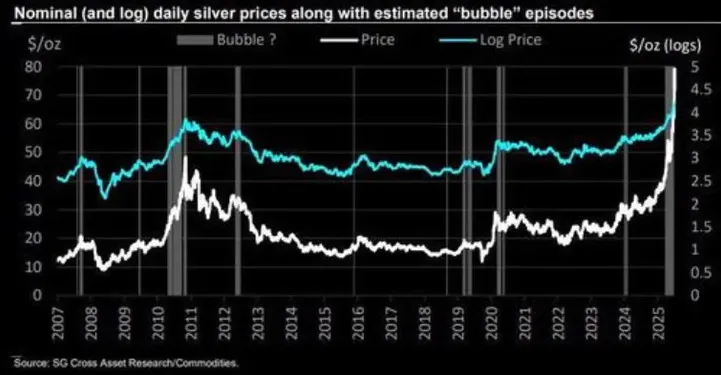
The key analytical issue is not whether prices are high, but whether they exhibit super-exponential behavior. In bubble diagnostics, this manifests as convex departures above an established exponential trend when viewed on a log scale. These deviations are often transient and, historically, have preceded regime shifts or sharp corrections.
To test for this dynamic, Société Générale applies the Log-Periodic Power Law Singularity framework, or LPPLS, a model designed to detect unstable price regimes rather than predict precise turning points.
What the LPPLS Model Signals
The LPPLS framework defines bubbles as periods in which prices accelerate super-exponentially toward a critical point, accompanied by increasingly frequent oscillations. When the model’s predicted price path diverges meaningfully above observed prices, a bubble regime is flagged.
Applied to silver, the model identifies the current regime as consistent with past bubble episodes. Some historical signals proved accurate, while others did not. Importantly, the bank cautions against interpreting this signal in isolation.
“If one were to rely solely on this model, the silver market could be described as being in a bubble. We firmly warn against this.”
The model is better understood as an instability detector rather than a directional forecast.
Liquidity Matters
Silver’s relatively low liquidity compared with gold materially affects model outcomes. Less liquid markets tend to exhibit amplified herding behavior, stronger feedback loops, and sharper price dislocations. These features are precisely what the LPPLS framework is designed to detect.
As a result, bubble signals appear more frequently in silver than in deeper markets, even when underlying fundamentals remain supportive.
Structural Backdrop Remains Supportive
Société Générale emphasizes that model-based signals should be weighed alongside broader fundamentals. The bank does not believe the LPPLS framework can forecast a reversal in silver’s momentum under current conditions.
The broader backdrop includes persistent physical deficits, elevated geopolitical uncertainty, and what the bank characterizes as a structural shift in precious metals driven by de-dollarisation dynamics.
China’s Export Restrictions and Physical Supply
Turning to supply, the bank views China’s forthcoming silver export controls as materially significant.
Beginning January 1, 2026, silver exports will move to a licensing regime administered by the Ministry of Commerce. Participation will be limited to select producers and traders meeting strict production, credit, and certification requirements. The policy mirrors prior restrictions imposed on other strategic materials and is expected to remain in place through at least 2027.
China supplies an estimated 60 to 70 percent of global refined silver. Export volumes could decline by as much as 30 percent under the new framework, exacerbating existing global deficits estimated at roughly 200 to 230 million ounces.
Section 232 and U.S. Policy Risk
The bank also expects clarity in mid-January on the U.S. Section 232 investigation into processed critical minerals, including silver.
Silver was added to the U.S. critical minerals list in August due to import reliance exceeding 60 percent. Should the Bureau of Industry and Security conclude that silver imports pose a national security risk, the President would have authority to impose tariffs or other trade measures.
COMEX futures markets appear to be positioning ahead of this potential outcome, with accumulation occurring well in advance of any formal decision window.
Assessment of Tariff Risk
While policy clarity is expected, Société Générale views tariffs on standard 1,000-ounce silver bars as unlikely. Were such measures imposed, OTC market tightness would intensify sharply as outbound U.S. shipments slowed or halted.
Conclusion
The bank concludes that while technical diagnostics flag instability risks, they do not invalidate the broader structural case for silver. Healthy corrections remain possible, but model signals alone do not justify a call for trend exhaustion.
LPPLS is treated as one tool among many, useful for identifying stress regimes rather than forecasting inflection points. In the current environment, physical constraints and policy developments remain the dominant drivers.
About the Author
Vincent Lanci is a commodity trader, Professor of MBA Finance (adj.) , and publisher of theGoldFixnewsletter.